At the time Gann & Palmer took over the yard from Pengelly & Gore, Francis had established a brokerage for boat sale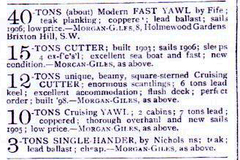
Holmwood advertisement 1907s but before long decided to move to London, and putting his experience to good use, established a small design practice specialising in small wooden cruising and racing craft as well as continuing with his brokerage.
The advertisement shown here was displayed in the appropriate magazines in 1907. To establish himself as a serious designer Francis successfully entered a number of competitions. In 1905 he won first prize in a competition run by 'The Yachtsman' magazine for the design of a motor yacht called Phantom II.
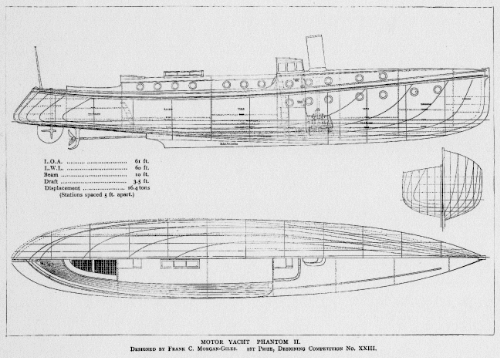 Competition winner Phantom II 1905
In 1907 he also won a design competition in 'Yachting Monthly' magazine for a 12ft dinghy called Hebe, the name he later called his Daughter born in 1918, which could be used 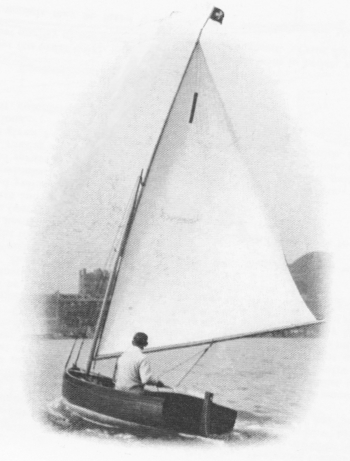 Francis Morgan Giles dinghy design Hebeas a tender or a yacht, this enabled him to progress rapidly in the field of dinghy design. He also designed a 34ft cutter called Glimpse and a 26ft day sailer, Yum Yum.
Frank needed to expand and in 1909 went into partnership with Harry May his dinghy racing friend from South Devon who had taken an active interest in the Exe and Starcross Yacht clubs and the work of the West of England Conference. They called themselves Morgan Giles and May, Naval Architects and Yacht Builders. They had offices in Southampton Street, London and a boatbuilding yard in Hammersmith, known as City Yard.
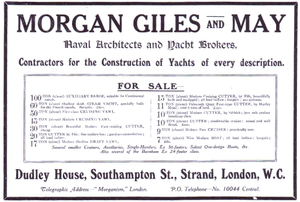 Morgan Giles & May advertisement 1909
The diary of Ivy Carus-Wilson, who later married Francis shows, despite it being a man’s world, she was a very keen and proficient dingy sailor and had Morgan Giles build her a 14ft Dinghy which she named Myosotis which Francis and Harry May delivered personally.
 Claire built for George May
Immediately after Myositis he designed a version with a heavier cast gunmetal centreplate. It won 8 firsts, 2 seconds and 1 third in 11 starts at the western regattas. Francis then went on the design and build yachts to the 6, 7 and 8 metre rating. Between 1910 and 1915 he designed and built fourteen, 6 metre Yachts, one 7 metre and one 8 metre. Many more were built at other yards both in the UK and abroad to his design. More were built after WW1. The first 6 metre, Claire was built for one of Harry May’s relative George May in 1910 which was superseded by Ouaniche in 1911.
Francis had continued racing success that added to his growing reputation and in 1911 in a move to expand the company they moved to a boat yard at Hythe on Southampton Water. Jonquil a 6 metre International Racing Class yacht was built for Captain RT Dixon and won 44 first prizes in 57 starts that summer. Another 6metre, Rarahu built in 1914 for Otto Wirth is still sailing as is Dana built in 1927.
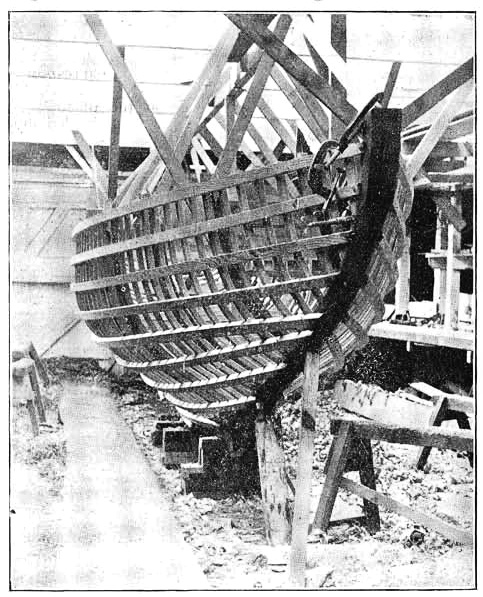 6 Metre under construction in Morgan Giles & May Yard in 1910
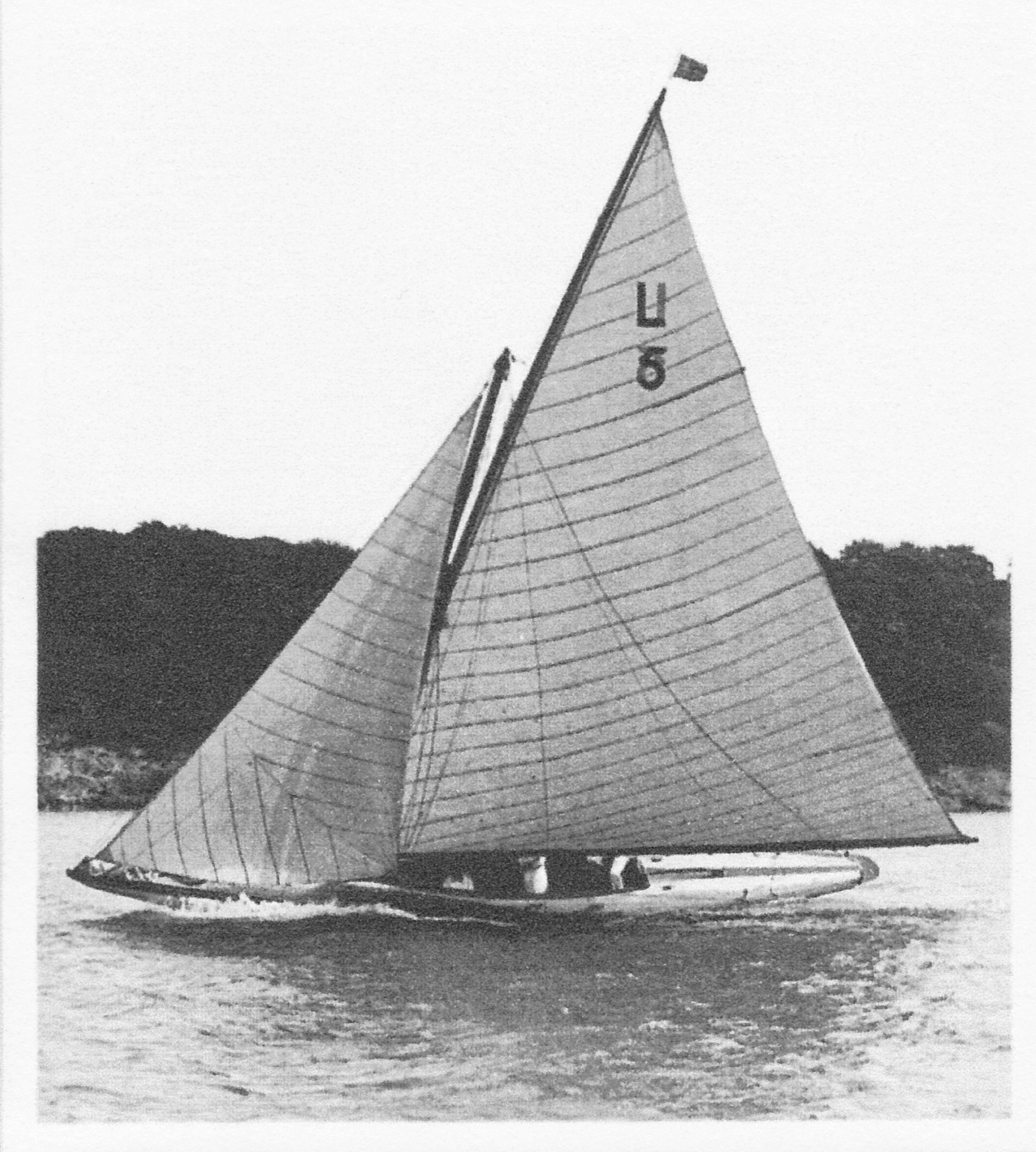 Jonquil
1912 brought a decline in dingy racing and increased interest in One-designs. Francis designed these for a number of clubs including the Thames Estuary, Essex, Teign and Dart clubs, the Royal North of Ireland dinghy, the Boat Racing Association and many others (See the One-design section under ‘The Vessels’)
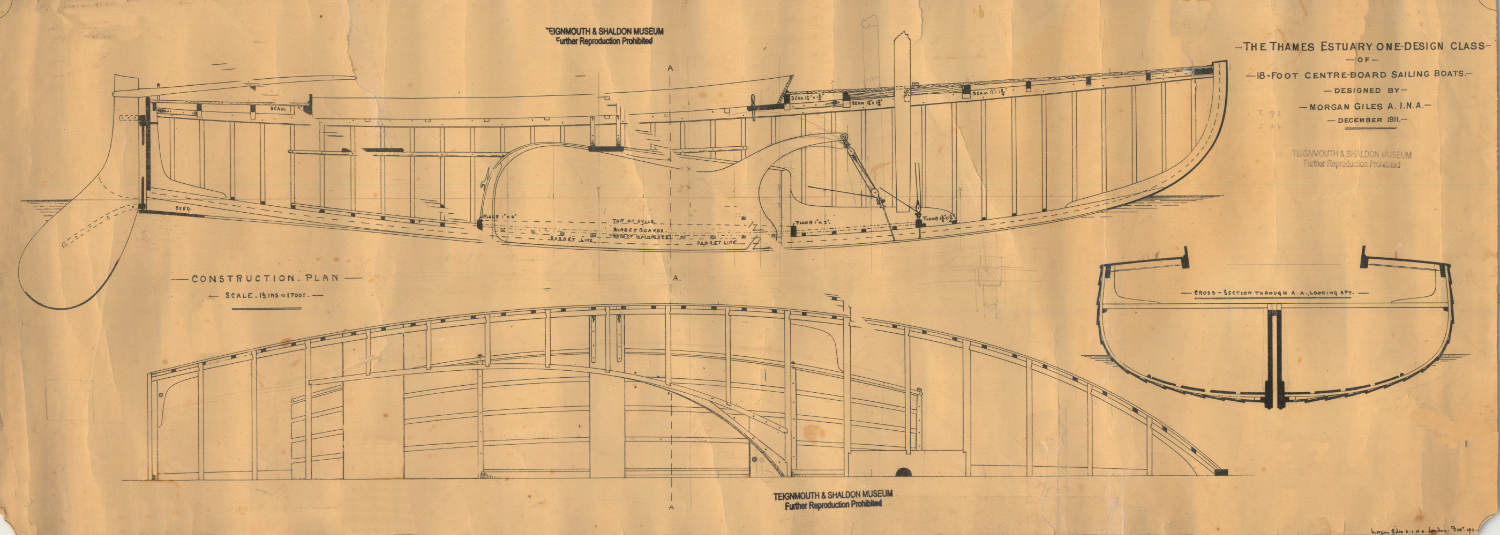 Thames Estuary One Design 1911
In March 1914 the company dissolved and Frank became an independent designer and yacht builder at Hamble but the 1914-18 war seriously affected the business.
Frank volunteered for the Royal Naval Auxiliary Patrol Service and suspended his business. He achieved the rank of Lieutenant RNVR and served on small patrol craft and the 80ft wooden motor launches on coastal patrol work.
 ML 325 Frank's wartime commision
During his service he suffered a serious health problem caused by the inhalation of engine fumes and spent recuperation time in Shaldon.
Discharged from the Navy in 1919 Frank wanted to continue to design small racing boats and build them in a yard of his own.

